
SERVICES
Planning, project controls and claims for construction contractors
Four service lines. Each one produces something you can put in front of the Engineer, the Employer or your own board.
01 · PROJECT PLANNING & SCHEDULING
Baseline Programmes preparation
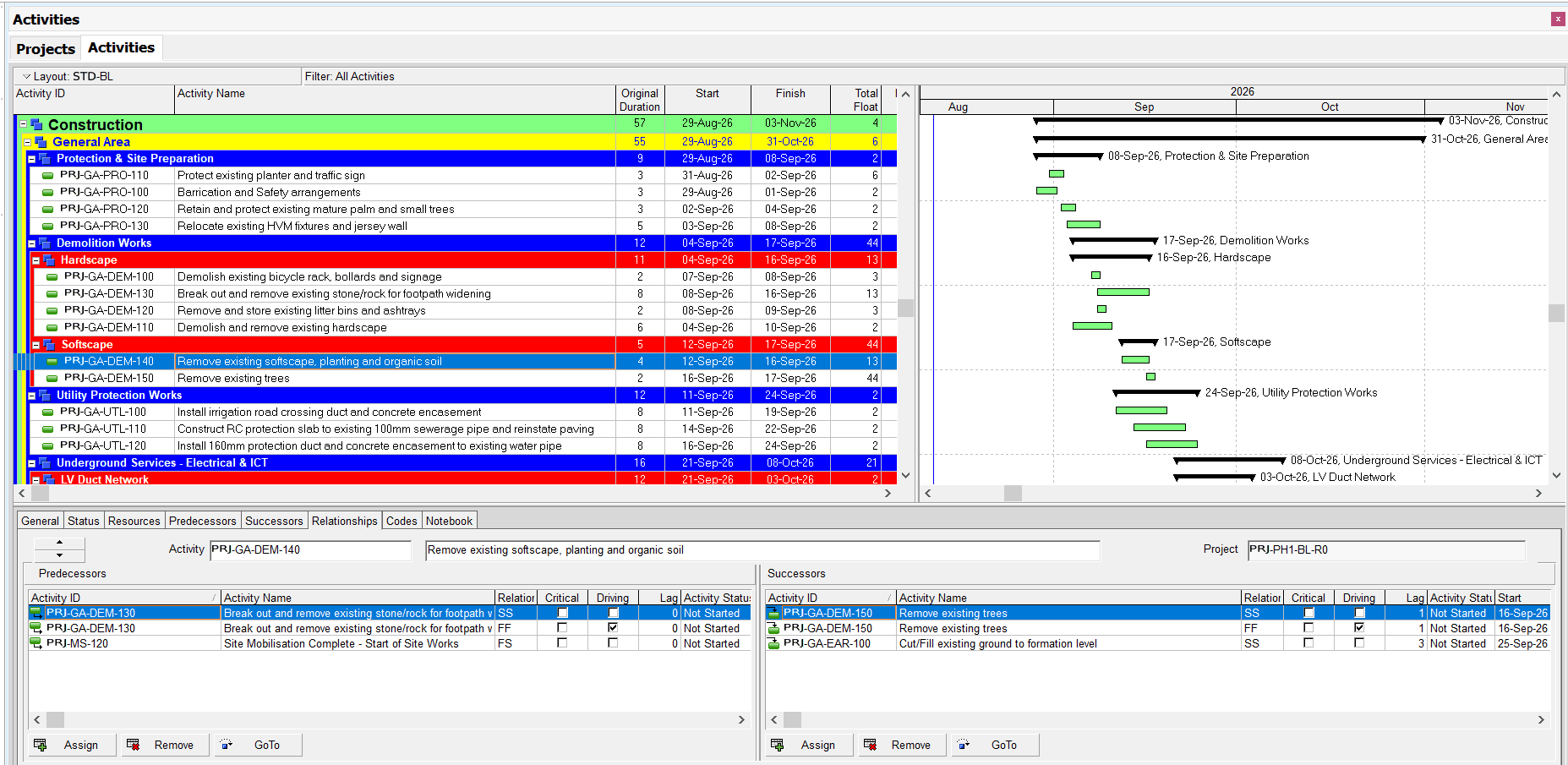
A good Baseline Programme lets you track every phase of the project properly — and that is what ultimately makes a project successful. Beyond the technical knowledge, it takes years of experience to build a programme that is both practical on site and contractually favourable.
Whether you need a new Baseline Programme, a revised submission, or help with review comments that keep coming back, we identify what is driving them and work with your team to close them out. We prepare Baseline Programmes (Clause 14, Clause 8.3), tender programmes, and revised or recovery programmes as required.
- Tender and bid programmes
- Baseline Programmes (Clause 14, Clause 8.3) in Primavera P6
- Resource, manpower and cash-flow loading
- Revised, recovery and acceleration programmes
- Programme health and logic reviews before submission
We build our own tools, too. Logic Line runs an in-house SaaS check that inspects Primavera programmes against the DCMA 14-point criteria, along with a range of additional logic and quality tests — so issues are caught before the programme is submitted, not after it is rejected.
02 · PROJECT CONTROLS
Reporting that tells management the truth early
Progress reporting should surface a problem while there is still time to act on it. We set up the measurement, the registers and the reporting cycle — and keep them running.
- Progress measurement and monthly programme updates
- Earned value, S-curves and productivity tracking
- Programme revision and change registers
- Risk and early-warning registers with owners and dates
- Executive reporting across a multi-project portfolio
- PlanningShare: your project controls in one live system


03 · DELAY ANALYSIS & EOT CLAIMS
Entitlement, particularised and defensible
From the first notice through to the Engineer’s determination. We build the delay case on the contract, the programme and the contemporaneous record — not on assertion.
- Notices and time-bar protection under FIDIC and NEC
- Time Impact Analysis and Windows Analysis (SCL Protocol)
- As-planned versus as-built and collapsed as-built
- Fully particularised EOT submissions
- Prolongation, disruption and thickening cost claims
- Responses to rejections and Engineer’s determinations
04 · RAMS — UK RESIDENTIAL
Contractor-ready Risk Assessments & Method Statements
Site-specific RAMS for UK residential works, written to be handed straight to a principal contractor or building control — not a generic template with your logo dropped on it.
- Extensions, refurbishments and loft conversions
- New-build residential works
- Site-specific hazards, controls and sequencing
- CDM-aware documentation
- Fixed per-document rates, fast turnaround
HOW AN ENGAGEMENT RUNS
From first call to a pack that survives the Engineer
01
Tell us what is happening
A short call or WhatsApp thread. Send the current programme (native P6 file if you have it), the approved baseline, the correspondence on the event and the dates that matter. You get an initial read on entitlement — usually the same working day.
02
Scope and fee agreed
Per deliverable, monthly retainer or hourly advisory, priced and agreed in writing before any work starts. No open-ended time charges, and no fee that moves after the fact.
03
We do the work
Programme built or re-based in Primavera P6. A fragnet modelled for each delay event, windows sliced update by update, the critical path tracked through every revision. Records assembled into a dated chronology tied back to the correspondence. You see drafts as they develop, not a finished PDF at the end.
04
Delivered and defended
A submission-ready pack: narrative, delay analysis, impacted programmes, chronology and supporting exhibits. Then support through the Engineer’s queries, the rejection letter and the determination — the stage where most claims are actually won or lost.
QUESTIONS WE GET ASKED
Before you get in touch
Do you work with subcontractors as well as main contractors?
Yes — a large share of the work is subcontractor-side, where entitlement is often weakest because notices and records sit with someone else. The approach is the same: establish the contractual route, then prove it with the programme and the record.
Our notice may already be late. Is it worth doing anything?
Almost always. Time-bar provisions vary in strength and application, and a late notice is rarely the end of a claim on its own. The first job is to establish where you actually stand, then protect what remains.
Which delay analysis method will you use?
Whichever the contract, the records and the SCL Protocol support — commonly Time Impact Analysis or Windows Analysis. Method selection is driven by the evidence available and the stage of the project, not by preference.
Can you work remotely on a UAE or UK project?
Yes. Most of the work — programming, analysis, drafting — is delivered remotely, with on-site attendance where the project needs it.
Do you use Primavera P6?
Yes, for planning, updating and forensic analysis. We can also work with native files you already hold and review a third party’s programme.
How quickly can you start?
For live notice and time-bar issues, usually within days. Message on WhatsApp with the deadline and we will tell you honestly whether we can meet it.
TOOLS, METHODS AND STANDARDS
We work to the standards your contract is judged against
Is a notice or submission deadline running?
Send the programme, the correspondence and the key dates. We will tell you what entitlement looks like, what is already at risk, and what it takes to secure it.